Tag: LBJ National Grasslands

  • A Morning at the Edge of Autumn

    (This first appeared in the Our Lives in Nature blog in 2022)

    The change of seasons can be imperceptible when one day is mostly like the last one. Sometimes, though, there is a day that feels like change has come. September 11, 2022, felt that way, and the LBJ National Grasslands was a great place to greet the new season. I drove toward Decatur in early morning, with the nearly full moon watching over me and the sun rising as an orange disk on the other side of the sky. But to the northwest, a blue-gray deck of clouds inched toward me. I reached the edge of the clouds at Decatur and left the moon and sun behind.

    In a small pine grove east of Alvord, the pine trees swayed in a cool breeze. They made a beautiful sound like water rushing as each wave of air poured through the pine needles. My thermometer registered 66 degrees, and we stood under the trees with one of us commenting that she was glad to have a jacket. 

    There was Dana, Erika, Carol, Carla, Kayla and me, most of them Master Naturalists and all of us naturalists in the sense of people who study the natural world and who return time and again to be lovingly, gratefully immersed in it.

    A field with lots of croton

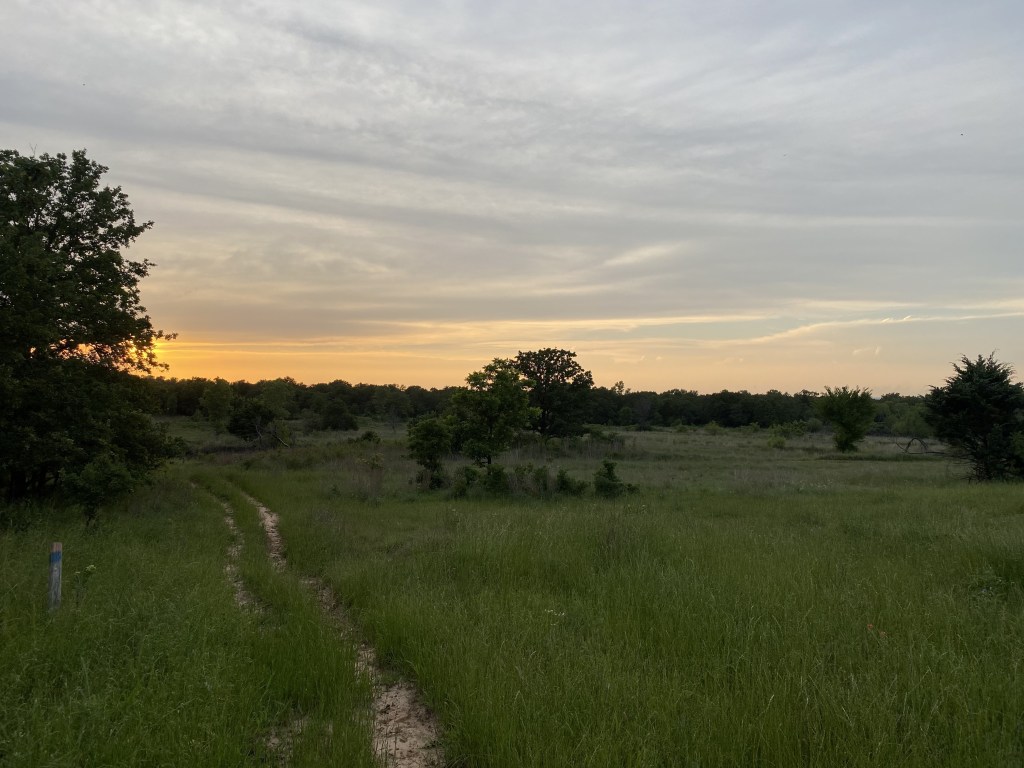
    Under the deck of gray clouds we began walking across open prairie patches and through areas of oak and juniper woodland, looking at the green growth after the prescribed fires from some months ago. Very soon after the fire the new growth had appeared, but the grasslands then had to endure months of heat and drought. The recent rains triggered something like a second spring, with lots of new green vegetation and beautiful flowers. Some of the meadows were full of croton, also known as “dove weed” or “goat weed,” and those fields had the different texture and color of those grayish green leaves. Kayla examined branches for lichen and found several beautiful varieties. Then we looked up in a dead tree to see a young Mississippi kite perched there, watching us with little apparent concern. We took photos and wondered if that brown-streaked bird was really a kite. As we did so, I noticed that the clouds were beginning to break up and the sky beyond was a beautiful blue. 

    A juvenile Mississippi kite

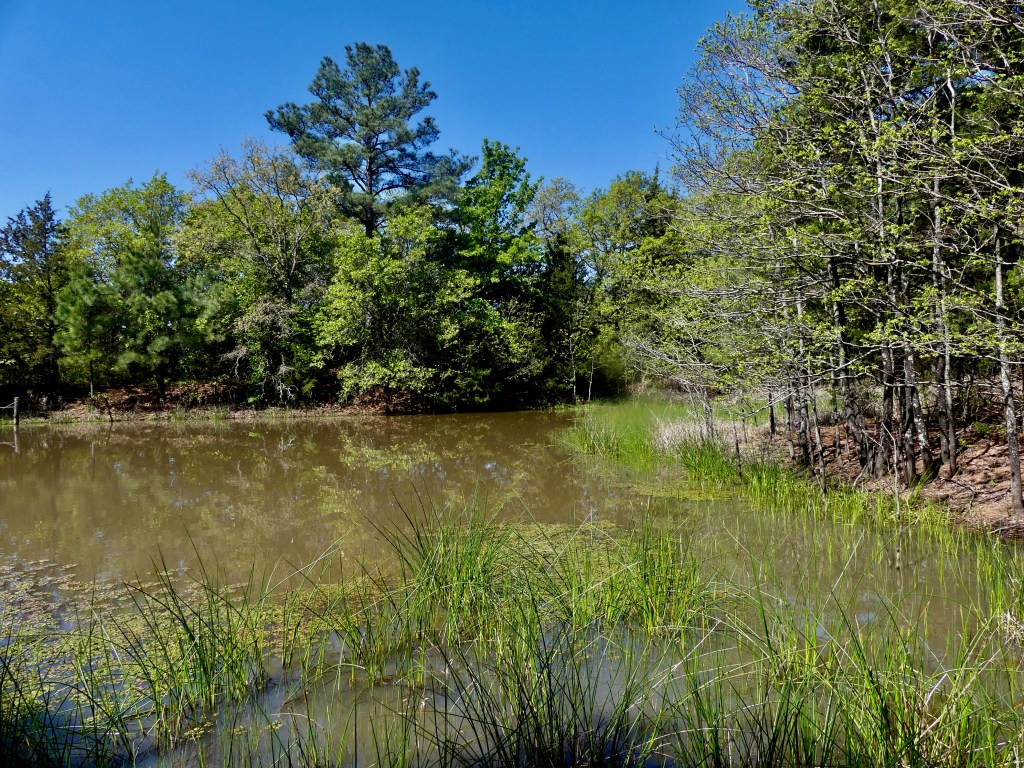
    We came to a couple of small ponds within an area where the sandy soil was eroded and scooped out. One of the ponds had what was nearly an island, a steep mound on which several trees grew, including some persimmons. Most of the developing fruits were green, but I found a ripe one and ate part of it. The texture was a little like plum and the taste was vaguely peachy. What a wonderful place this was!

    The boundary of this little place was a low eroded embankment where the woodland gave way to the basin that held the pond. My companions were scattered near the pond, sitting quietly to write something about what we were experiencing. A breeze came down and stirred a patch of ripples in the water. Above the embankment, some sumac was starting to turn red, and the oak trees moved with each current of air. Those trees sheltered so much life in feathers, scales, chitin and fur. Above the tree line, soft clouds drifted and the sky behind them was deep blue shading to pastel toward the horizon. In the distance, a group of crows fussed at something. 

    This is the part I love the most – quiet, wordless moments just taking everything in or reflecting on where we had been. A member of our group wrote about the quiet, the rippling water and “sense of separation from today’s world.” This is a place of refuge from cities and never-sleeping machinery. This is a sanctuary in which we can be still, feel the sun’s warmth and the soft breezes, and listen to birds. I didn’t want to leave. I wanted to sit among the bitterweed and sedges and talk with the cricket frogs.

    A hatchling whiptail lizard, either a prairie racerunner or spotted whiptail

    The time came to an end, however, and we started back. Somewhere we noticed some movement in the leaf litter and I was enthralled with a tiny striped lizard with the most beautiful blue-green tail. Stripes and blue tail send my mind immediately to the thought that it was a baby skink, but the details of body form and pattern made clear that this was a newly hatched whiptail lizard. A couple of us watched as this tiny reptile hunted invertebrates under the leaves, biting and shaking and then chasing the ant-sized insect again. I was grateful that he or she decided to ignore us and continue hunting as we watched. Just another moment of fascination and beauty within these woods and prairies. 

    More summer-like days will come, but the sun is lower in the sky now and the heat of the day is nothing like July. There will be more walks as we slip into autumn. I look forward to joining friends for another day at the grasslands. 

    Hairy ruellia, a kind of petunia, grew here and there in woodland openings
    A false foxglove, as identified by iNaturalist
  • Finding Our Way in the Prairies and Woods

    I know my way around most of the LBJ National Grasslands (LBJNG), in Wise County. I have driven up there more times than I can remember over the past 25 years, and I can navigate that network of county roads, day or night. In several of the Grassland’s units where I often walk, I can follow the network of trails without taking a wrong turn. I have to add that any turn you take is likely to bring you to some new meadow, some new hidden pond, or another dense oak woodland; it’s only a “wrong” turn if you are nearly out of water or time and needing to get back to the car.

    LBJ National Grasslands, Unit 30

    To a lesser degree, I know my way around the nature of North Texas. That knowledge is about what the land and water are like, being able to recognize many of the plants, fungi, and animals of the region, and having some understanding of how it all works together. When land managers know such things, they can help us avoid wrong turns that can harm the ecoregion. The more our teachers can navigate the natural history of the Cross Timbers, the better they are at teaching and inspiring a new generation of nature kids. And when individuals and families know something about the trees, grasses, grazers, predators, and all the rest, they are better equipped to find their way home. Our goal in Cross Timbers Connection is to offer the tools and share the needed experiences to help us find our way.

    As I was first exploring LBJNG, two things helped me find my way around. One was an ability that comes from real-world experience. With practice over the years wandering roads through wild or semi-wild places, you get to where you kind of know which way you’re headed and where you came from. That knowledge lets you backtrack as if you had a map in your head, sort of. And in fact, most of us do. Finding your way around in places like that trains your brain and builds your spatial memory and spatial reasoning. Like a muscle, the more you use it, the stronger it becomes. The hippocampus and other areas within the brain get pretty good at knowing where you are and how you got there.

    The other thing that helped me navigate the Grasslands was a paper map. Not a GPS app that tells you to take this turn and that to get to a destination; a map – a picture of the landscape and its roads, which my brain could (on a good day) remember and visualize from different directions. And so, coming up to the intersection of County Road 2475 and 2675, where the road seems to split around a small, steep hill, I could say, “If I go to the left, I wind up circling around and going through some nice habitat before coming back to 2675.” Before that route was locked into my memory from experience, I could visualize it from the map. Maps are useful tools for finding your way.

    LBJ National Grasslands, Unit 29

    Later, of course, GPS apps became a thing. We all have mapping apps on our phones, and we plug in the destination and the phone tells us, “turn left” and “turn right,” and then we arrive. We didn’t have to pay much attention to how we got there. For some people for whom visualizing direction is inherently difficult, it is an important support. For most of us, it sidesteps the brain skills I mentioned above. We become dependent on the mapping program in our phone, not the one in our brain. In one study, fifty drivers were questioned about their lifetime use of GPS and then presented with virtual navigation tasks (without the app). Those with greater lifetime GPS use had poorer navigation abilities. And, three years later, those spatial ability skills declined even further with continued GPS use[i]. (Full disclosure: I do use GPS apps, particularly in urban settings, both for the route and for reports of traffic congestion.)

    My point is that navigation using experience and “analog” tools is a pretty good metaphor for how we understand nature and natural history. Direct experience is extremely helpful, as are intellectual, perceptual, and even emotional or cultural tools. Those tools should build “maps” based on information that helps us tie different things together, allowing us to see the big picture.

    We may start with knowing what a species looks like. While walking in the Cross Timbers, something looks back at us from across a meadow. Standing alert and attentive, with those yellow eyes sizing up our potential for threat, pointed ears up, catching every sound. That long muzzle, white around the mouth, the bushy tail, the graceful body with tawny and grizzled gray fur. Too big for a fox and too small for a wolf. A coyote, Canis latrans. By the time this has registered, the coyote turns and disappears into the brush.

     A naturalist’s calling is to know more – the details of its habitat, the variety of its prey and predators, the phenology of its life from day to day, season to season, and (the subjective part) how we and others respond to its form, beauty, utility, perceptions of its skill or ability to persevere, and its place in the world. Or even to take what we observe and create stories that guide or enrich our own lives. I’m thinking, for example, of the Indigenous stories and myths about the coyote. It’s not that we should confuse our personal or cultural reactions with objective data about coyotes. It’s just that we have a richer and more complete understanding of coyotes if we have the whole picture.

    Our aim is to be a resource that helps us find our way in the woods and prairies and to get to know all of it in a more holistic way. The articles in the Post Oak & Prairie Journal, the website, and other things we will do should help connect all of us with places, with plants, animals, and ecological communities. We would like Cross Timbers Connection to be a sort of meeting place for the naturalist community where some provide articles for the journal, some make use of the website, and everyone shares their ideas, hopes, and suggestions. We imagine bringing that naturalist community together (face-to-face and digitally) and spreading the word about others who are hosting meetings and doing other good work. What would that look like in your part of the naturalist neighborhood? We would love to hear from you (using the Contact form or emailing masmith.tx@gmail.com).

    A pond within Unit 30 of LBJ National Grasslands

    [i] Dahmani, L. & V.D. Bohbot. 2020. Habitual use of GPS negatively impacts spatial memory during self-guided navigation. Sci Rep 10, 6310, https://doi.org/10.1038/s41598-020-62877-0