Category: In the Field

  • A Morning at the Edge of Autumn

    (This first appeared in the Our Lives in Nature blog in 2022)

    The change of seasons can be imperceptible when one day is mostly like the last one. Sometimes, though, there is a day that feels like change has come. September 11, 2022, felt that way, and the LBJ National Grasslands was a great place to greet the new season. I drove toward Decatur in early morning, with the nearly full moon watching over me and the sun rising as an orange disk on the other side of the sky. But to the northwest, a blue-gray deck of clouds inched toward me. I reached the edge of the clouds at Decatur and left the moon and sun behind.

    In a small pine grove east of Alvord, the pine trees swayed in a cool breeze. They made a beautiful sound like water rushing as each wave of air poured through the pine needles. My thermometer registered 66 degrees, and we stood under the trees with one of us commenting that she was glad to have a jacket. 

    There was Dana, Erika, Carol, Carla, Kayla and me, most of them Master Naturalists and all of us naturalists in the sense of people who study the natural world and who return time and again to be lovingly, gratefully immersed in it.

    A field with lots of croton

    Under the deck of gray clouds we began walking across open prairie patches and through areas of oak and juniper woodland, looking at the green growth after the prescribed fires from some months ago. Very soon after the fire the new growth had appeared, but the grasslands then had to endure months of heat and drought. The recent rains triggered something like a second spring, with lots of new green vegetation and beautiful flowers. Some of the meadows were full of croton, also known as “dove weed” or “goat weed,” and those fields had the different texture and color of those grayish green leaves. Kayla examined branches for lichen and found several beautiful varieties. Then we looked up in a dead tree to see a young Mississippi kite perched there, watching us with little apparent concern. We took photos and wondered if that brown-streaked bird was really a kite. As we did so, I noticed that the clouds were beginning to break up and the sky beyond was a beautiful blue. 

    A juvenile Mississippi kite

    We came to a couple of small ponds within an area where the sandy soil was eroded and scooped out. One of the ponds had what was nearly an island, a steep mound on which several trees grew, including some persimmons. Most of the developing fruits were green, but I found a ripe one and ate part of it. The texture was a little like plum and the taste was vaguely peachy. What a wonderful place this was!

    The boundary of this little place was a low eroded embankment where the woodland gave way to the basin that held the pond. My companions were scattered near the pond, sitting quietly to write something about what we were experiencing. A breeze came down and stirred a patch of ripples in the water. Above the embankment, some sumac was starting to turn red, and the oak trees moved with each current of air. Those trees sheltered so much life in feathers, scales, chitin and fur. Above the tree line, soft clouds drifted and the sky behind them was deep blue shading to pastel toward the horizon. In the distance, a group of crows fussed at something. 

    This is the part I love the most – quiet, wordless moments just taking everything in or reflecting on where we had been. A member of our group wrote about the quiet, the rippling water and “sense of separation from today’s world.” This is a place of refuge from cities and never-sleeping machinery. This is a sanctuary in which we can be still, feel the sun’s warmth and the soft breezes, and listen to birds. I didn’t want to leave. I wanted to sit among the bitterweed and sedges and talk with the cricket frogs.

    A hatchling whiptail lizard, either a prairie racerunner or spotted whiptail

    The time came to an end, however, and we started back. Somewhere we noticed some movement in the leaf litter and I was enthralled with a tiny striped lizard with the most beautiful blue-green tail. Stripes and blue tail send my mind immediately to the thought that it was a baby skink, but the details of body form and pattern made clear that this was a newly hatched whiptail lizard. A couple of us watched as this tiny reptile hunted invertebrates under the leaves, biting and shaking and then chasing the ant-sized insect again. I was grateful that he or she decided to ignore us and continue hunting as we watched. Just another moment of fascination and beauty within these woods and prairies. 

    More summer-like days will come, but the sun is lower in the sky now and the heat of the day is nothing like July. There will be more walks as we slip into autumn. I look forward to joining friends for another day at the grasslands. 

    Hairy ruellia, a kind of petunia, grew here and there in woodland openings
    A false foxglove, as identified by iNaturalist
  • New Class Finds Herps at the Nature Center

    If I could choose any time to take new Master Naturalists into the field looking for herps, it would not be at the end of summer. The Fort Worth Nature Center & Refuge rarely disappoints, and so we found several reptiles and amphibians yesterday, despite the odds.

    I have been teaching incoming Master Naturalists at the Cross Timbers chapter about reptiles and amphibians (herps) for years, and it is always a great experience. Some of them already have some interest and experience with these animals and almost all have the curiosity and enthusiasm that makes for a great class.

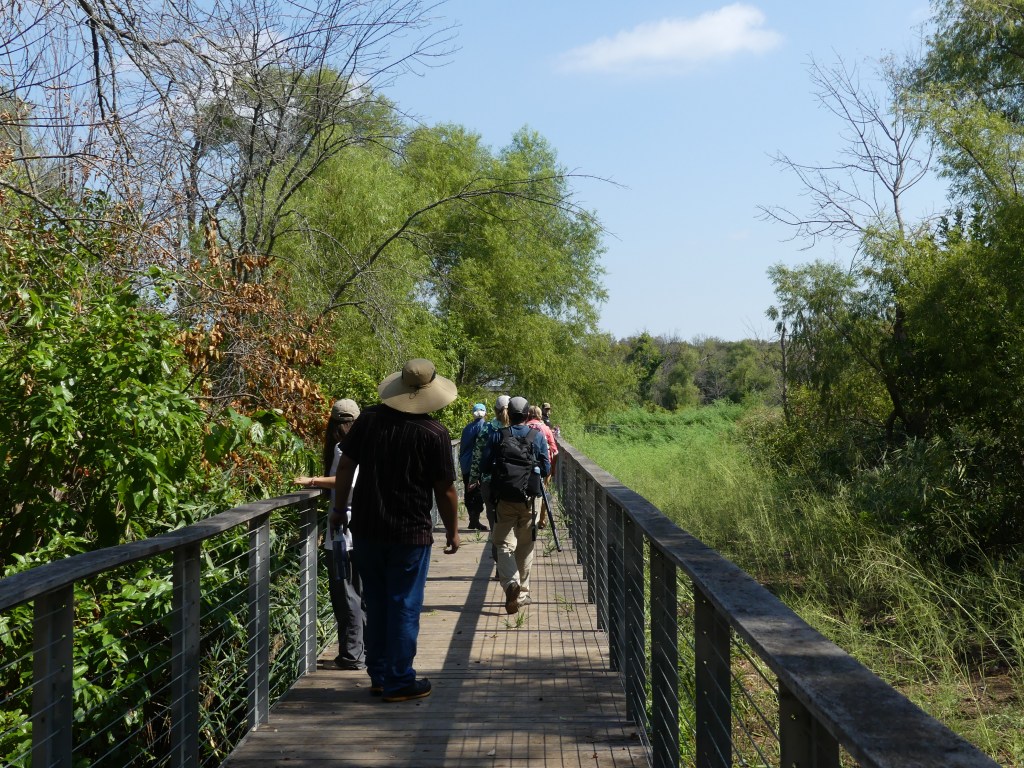
    A Master Naturalist class from 2023, on the Marsh Boardwalk

    A great class but I wondered if it would be a great field trip. Since late July, high temperatures have been at or above 100F every day, with three exceptions. On the Saturday of our outing, it had been 51 days without rain, so I wondered if we would be able to find something.

    Starting at 9:00am, the first of three groups checked the Marsh Boardwalk. Sometimes we find green treefrogs stuck to plant stems and leaves, trying to get some sleep. We did not see treefrogs, though later the next group would find a beautiful female Texas spiny lizard in the ambush position on a big willow tree trunk.

    We headed down the old two track road into the bottomlands. Brent Franklin, dragonfly expert and part of the leadership of the Cross Timbers Master Naturalists, was with us. So was Shaylin Daji, a guy who completed training in years past and who has a real interest and talent for finding herps. You couldn’t find better co-leaders on a walk like this.

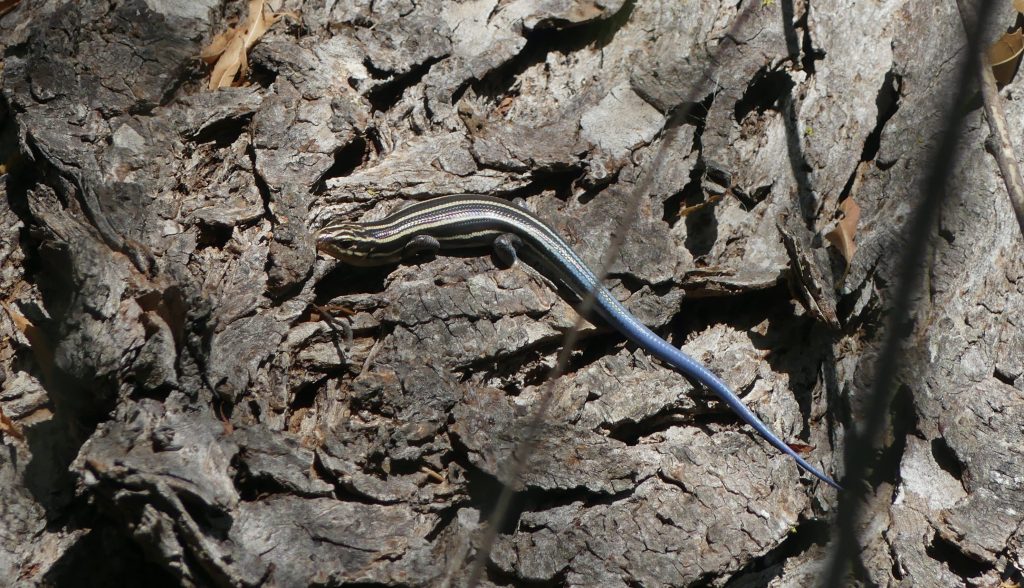
    A young skink whose blue tail is beginning to fade, seen during the 2023 field trip

    We almost always find something as we walk down that road. On our mid-morning walk, Brent and Shay found a young skink under a log alongside the road. It was either a five-lined skink (Plestiodon fasciatus) or a broad-headed skink (Plestiodon laticeps) – determining which one requires looking at details of scalation on the head, and we weren’t able to get that kind of close look.

    On the walk with the last group of the day, we found what was undoubtedly the same skink again, in the same place. We had a sort of Three Stooges moment as Brent, Shay, and I tried to get the lizard to stop for a moment out in the open, or perhaps we could capture it. The hardest part may be the care required to make sure that we did not break the skink’s tail off. I would much prefer to see it escape than to do that. The skink could grow another tail, but it’s not like grabbing one at Wal-Mart on the “body parts” aisle. Lizard tails require time and energy to grow or re-grow, and losing the tail puts them at a disadvantage.

    So we got several good glimpses at this lizard, but nothing more. It was young and so it still had the bright blue tail that juveniles have, with the color fading as the skink reaches maturity. Same with the bright lines on a dark body; females keep some semblance of lines in adulthood, while the males become a plain, light brown. Their jowls have an orange tint which becomes brighter during breeding season.

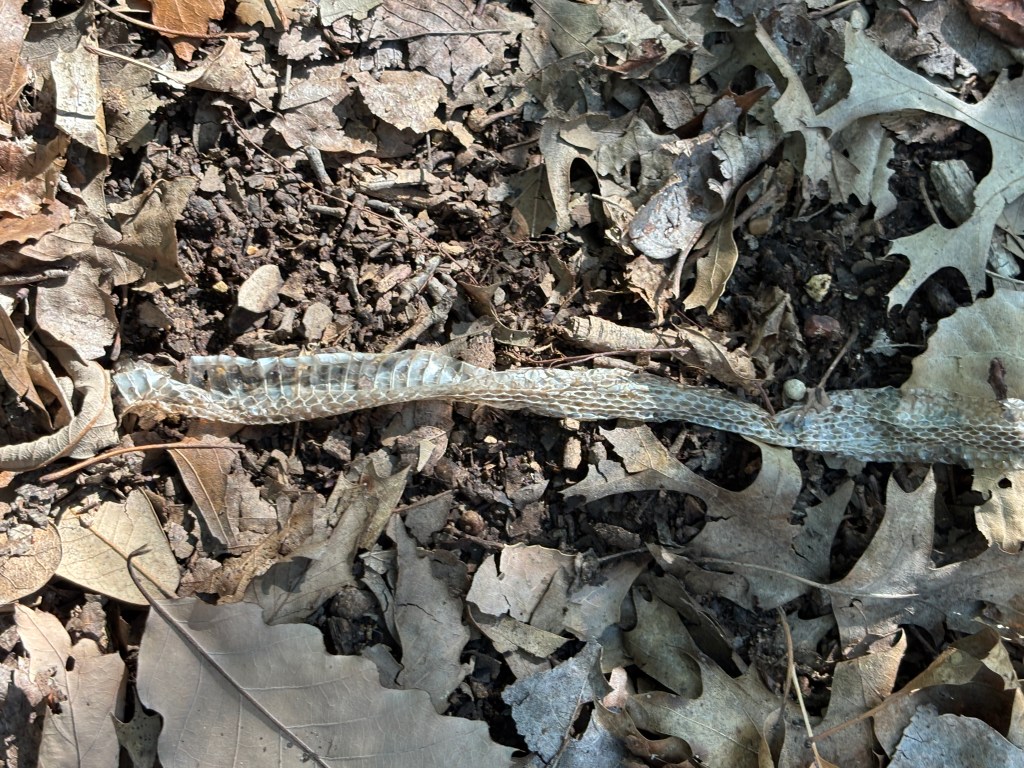
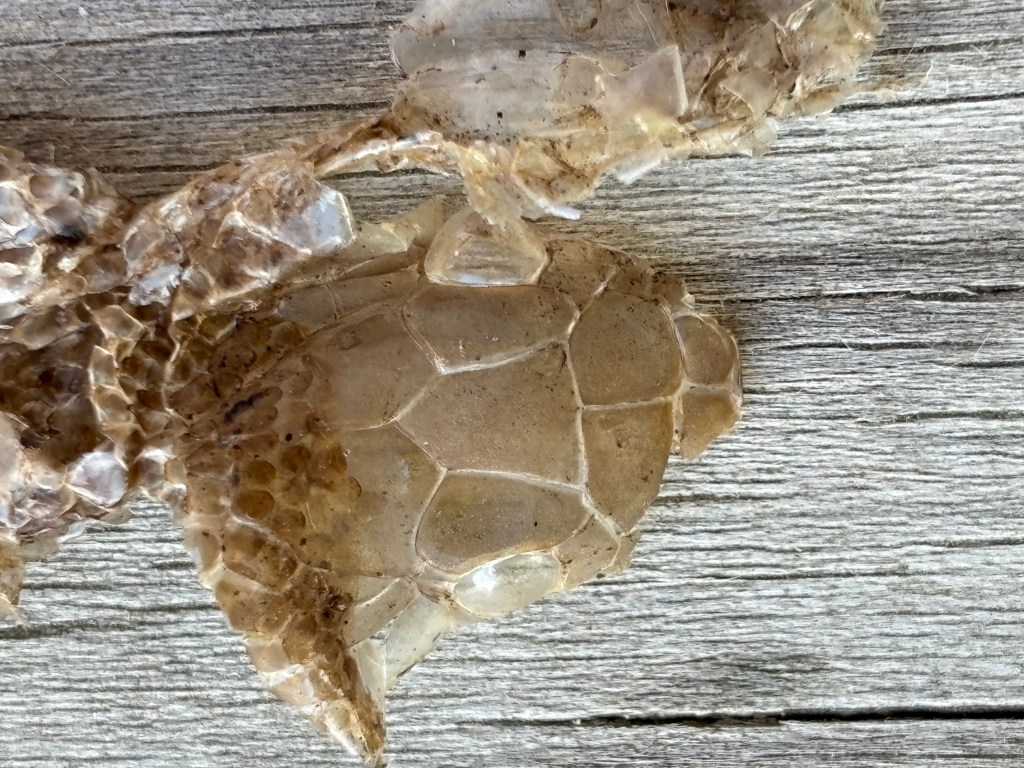
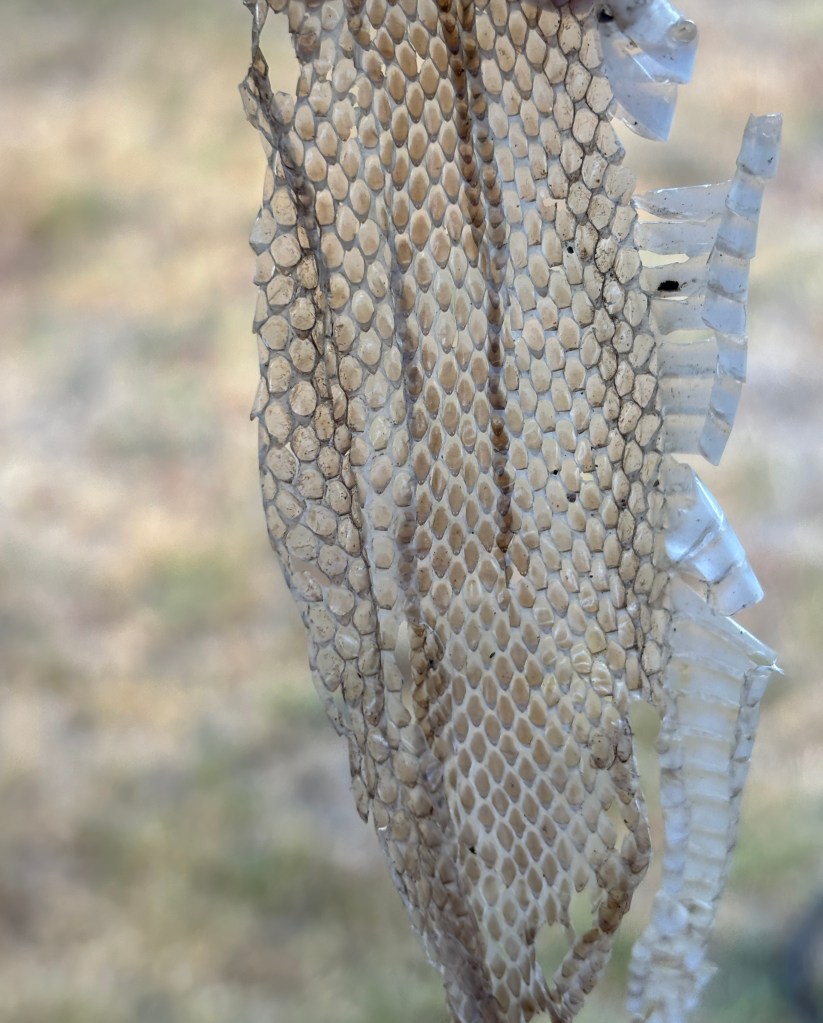
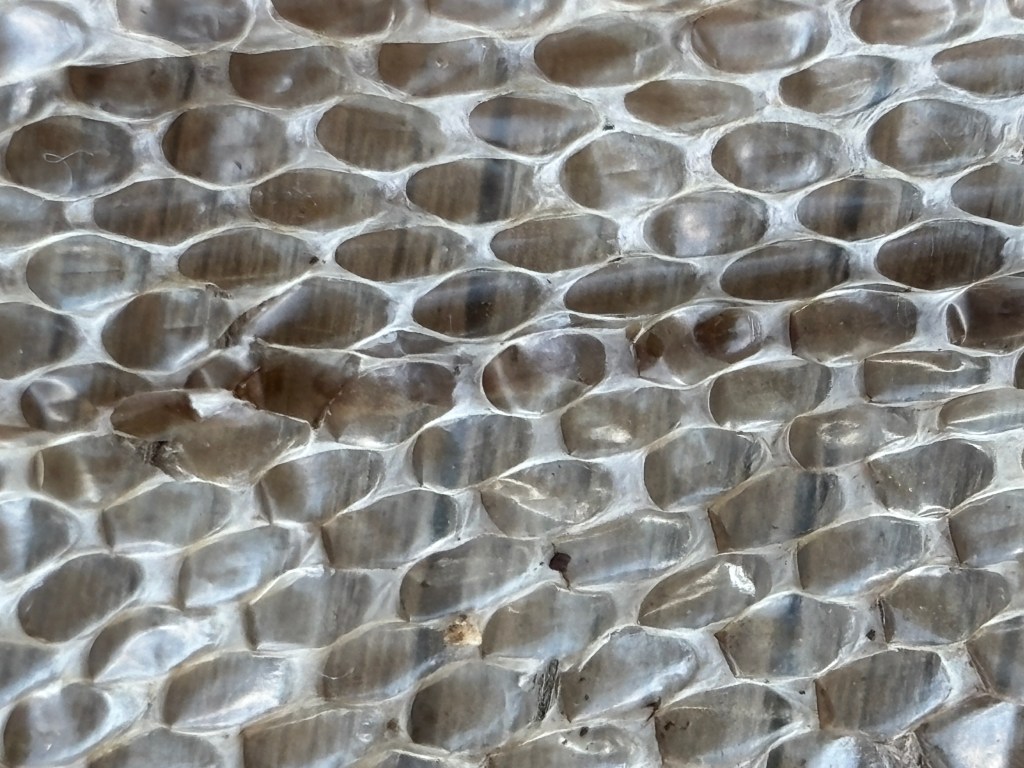
    The other thing we found near the road was a shed snake skin, with the head and first half or more of the skin intact. Often we can identify the snake (or narrow down the possibilities) by carefully examining it. Are the dorsal scales bigger, or smaller? Are they keeled? Can we detect any pattern in the shed skin? Looking at it in the field, we agreed that the dorsal scales looked smooth and there was a suggestion of a striped pattern.

    Later, I dampened the skin to make it flexible and cut it at the edge of the dorsal scales so the tube of skin could be laid it and examined better. The trace of pattern now seemed more like alternating patches of dark and light (blotches down the back) and a really close look seems to show slight keels in the scales in the middle of the back. What was puzzling in the field seems likely to have been from a juvenile western ratsnake (Pantherophis obsoletus).

    The bottomland forest is an area with ash, cottonwood, hackberry, and other trees that can withstand periodic flooding. The ground is covered with a latticework of downed branches and logs, and that ordinarily provides lots of opportunities to see herps and other critters. The soil was dry, even under pieces of bark or branches that we turned over.

    But at some point, someone flushed a mouse (my best guess was white-footed mouse, Peromyscus leucopus but it’s only a guess) that ran up the base of an ash tree under loose bark. As we were trying to get a look without pulling bark off the tree, someone said “Copperhead!” and our attention quickly shifted to a beautiful snake at the base of the tree.

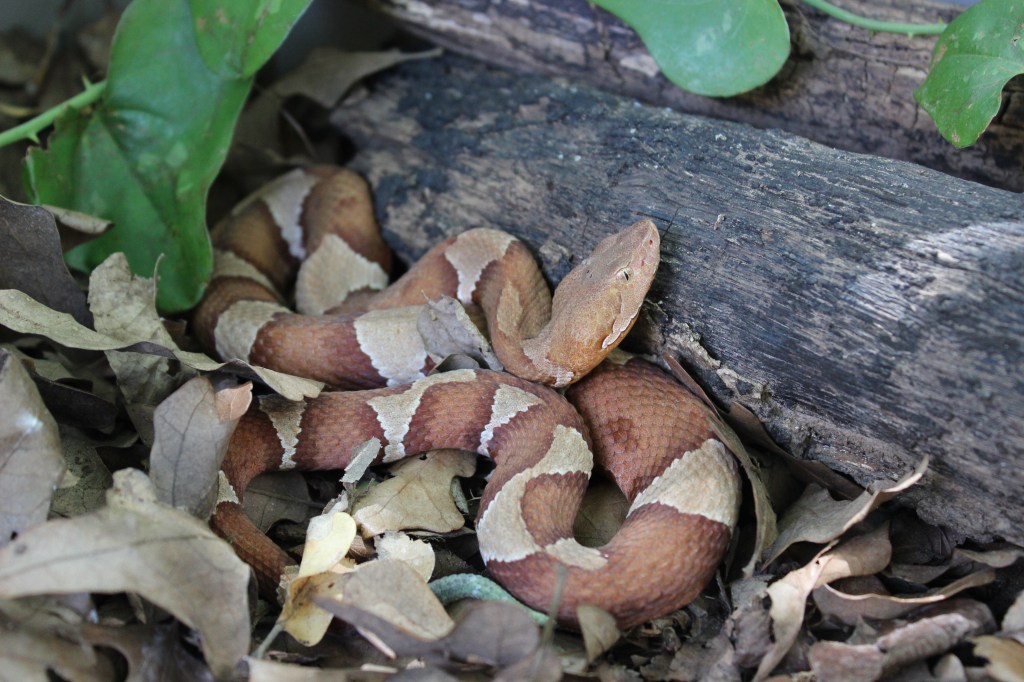
    Another broad-banded copperhead, this one from LBJ National Grasslands

    As it tried to get away, I used a snake hook to try to pull the copperhead back to the tree. I thought that, with a tree trunk behind it, the snake might feel less vulnerable and stop to see what threat it was facing. My goal was for the other participants to get a good look at the snake before we let it go its way. Often a pit viper such as this one, after being pulled back a time or two with a hook, will coil up momentarily. Not this one. This broad-banded copperhead (Agkistrodon laticinctus, according to the latest taxonomy) got under a big log and there was no getting it out.

    From the other side of the log, Shay was able to help the others see a bit of the snake’s coil under the log, but the copperhead stayed put. We found him or her as each of the subsequent two groups of Master Naturalists came through the area, sometimes with the snout visible and watching for danger, but never willing to emerge.

    Participants found a rough earthsnake or two (Haldea striatula) and a couple of Gulf Coast toads (Incilius nebulifer), and – being Master Naturalists – they admired all kinds of other things including the ironclad beetle (Zopherus nodulosus haldemani), a recluse spider (Loxosceles sp.), and a wolf spider (probably Hogna sp.)

    By early afternoon the temperature was reaching 100 degrees and we were wrapping up a good day at the nature center, really a better outing than I might have expected.

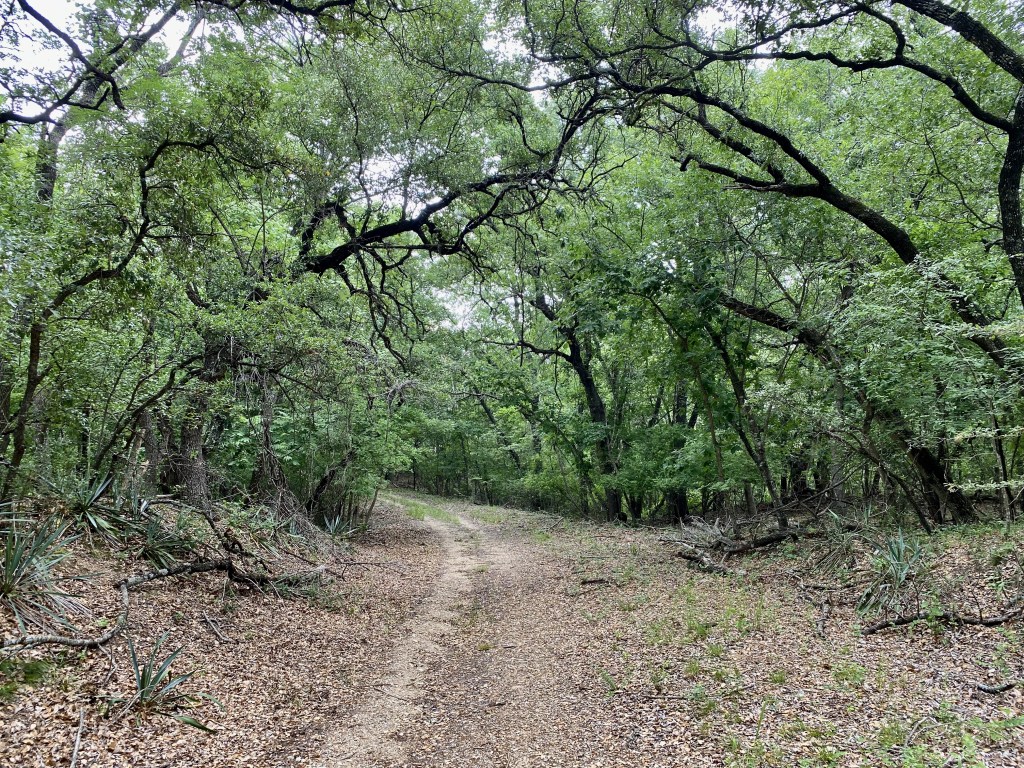
    The road into the bottomlands, seen in 2022

    I also managed to put in the good word for keeping field notes with some of the groups. Because it would be hard in that context to stop frequently and get the notebook out, I dictated some things about the location, weather, and then each of the herps we found and what they were doing. I warned the students that dictating notes runs the risk that you never get around to transcribing them into a notebook.

    I also promoted the use of good field guides. As wonderful as iNaturalist is, I don’t think it would give us information about the scale differences that would let us determine which of the skinks we saw. And good field guides provide some natural history information that can be helpful in the field. As I told the incoming Master Naturalists, knowing about things like habitat or diel (day vs. night, etc.) activity can help you know how to look for certain species.

    So, a “thank you” to the Master Naturalists for hanging in there, combing through the woodland, asking good questions, and being good observers on this outing. Hope to see you again.