Author: Michael Smith

  • New Class Finds Herps at the Nature Center

    If I could choose any time to take new Master Naturalists into the field looking for herps, it would not be at the end of summer. The Fort Worth Nature Center & Refuge rarely disappoints, and so we found several reptiles and amphibians yesterday, despite the odds.

    I have been teaching incoming Master Naturalists at the Cross Timbers chapter about reptiles and amphibians (herps) for years, and it is always a great experience. Some of them already have some interest and experience with these animals and almost all have the curiosity and enthusiasm that makes for a great class.

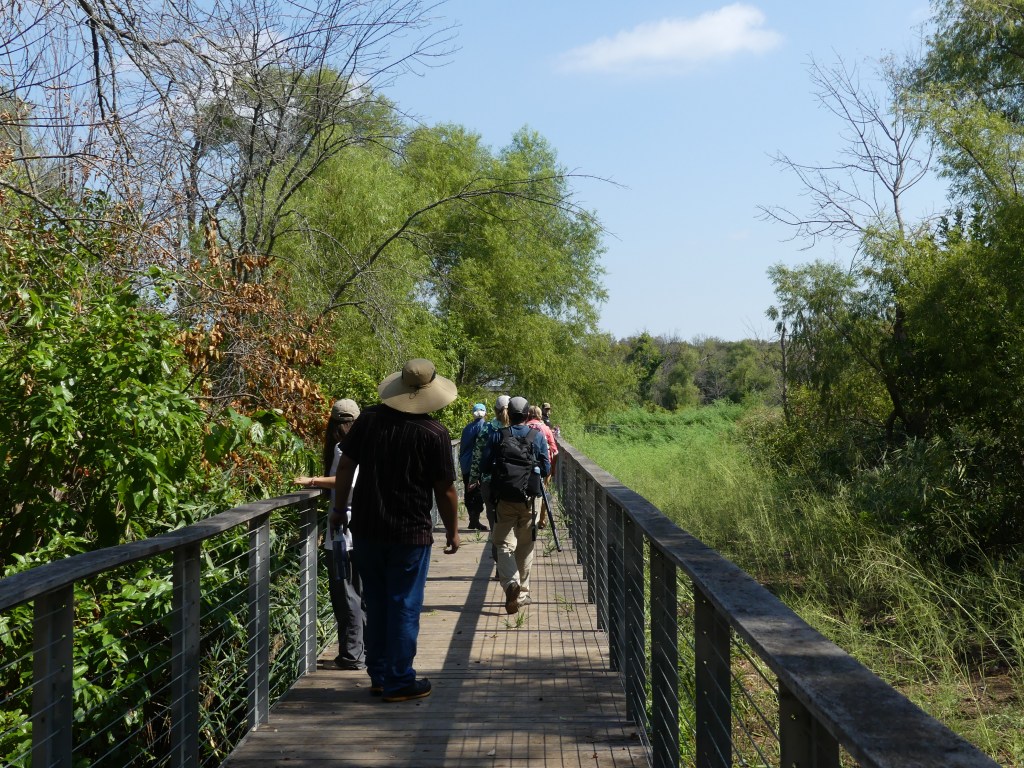
    A Master Naturalist class from 2023, on the Marsh Boardwalk

    A great class but I wondered if it would be a great field trip. Since late July, high temperatures have been at or above 100F every day, with three exceptions. On the Saturday of our outing, it had been 51 days without rain, so I wondered if we would be able to find something.

    Starting at 9:00am, the first of three groups checked the Marsh Boardwalk. Sometimes we find green treefrogs stuck to plant stems and leaves, trying to get some sleep. We did not see treefrogs, though later the next group would find a beautiful female Texas spiny lizard in the ambush position on a big willow tree trunk.

    We headed down the old two track road into the bottomlands. Brent Franklin, dragonfly expert and part of the leadership of the Cross Timbers Master Naturalists, was with us. So was Shaylin Daji, a guy who completed training in years past and who has a real interest and talent for finding herps. You couldn’t find better co-leaders on a walk like this.

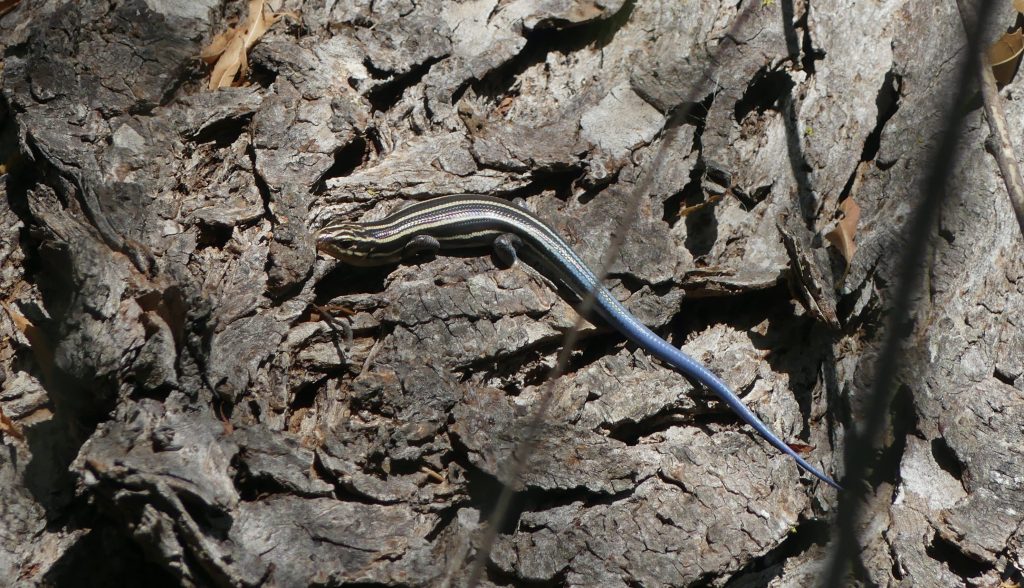
    A young skink whose blue tail is beginning to fade, seen during the 2023 field trip

    We almost always find something as we walk down that road. On our mid-morning walk, Brent and Shay found a young skink under a log alongside the road. It was either a five-lined skink (Plestiodon fasciatus) or a broad-headed skink (Plestiodon laticeps) – determining which one requires looking at details of scalation on the head, and we weren’t able to get that kind of close look.

    On the walk with the last group of the day, we found what was undoubtedly the same skink again, in the same place. We had a sort of Three Stooges moment as Brent, Shay, and I tried to get the lizard to stop for a moment out in the open, or perhaps we could capture it. The hardest part may be the care required to make sure that we did not break the skink’s tail off. I would much prefer to see it escape than to do that. The skink could grow another tail, but it’s not like grabbing one at Wal-Mart on the “body parts” aisle. Lizard tails require time and energy to grow or re-grow, and losing the tail puts them at a disadvantage.

    So we got several good glimpses at this lizard, but nothing more. It was young and so it still had the bright blue tail that juveniles have, with the color fading as the skink reaches maturity. Same with the bright lines on a dark body; females keep some semblance of lines in adulthood, while the males become a plain, light brown. Their jowls have an orange tint which becomes brighter during breeding season.

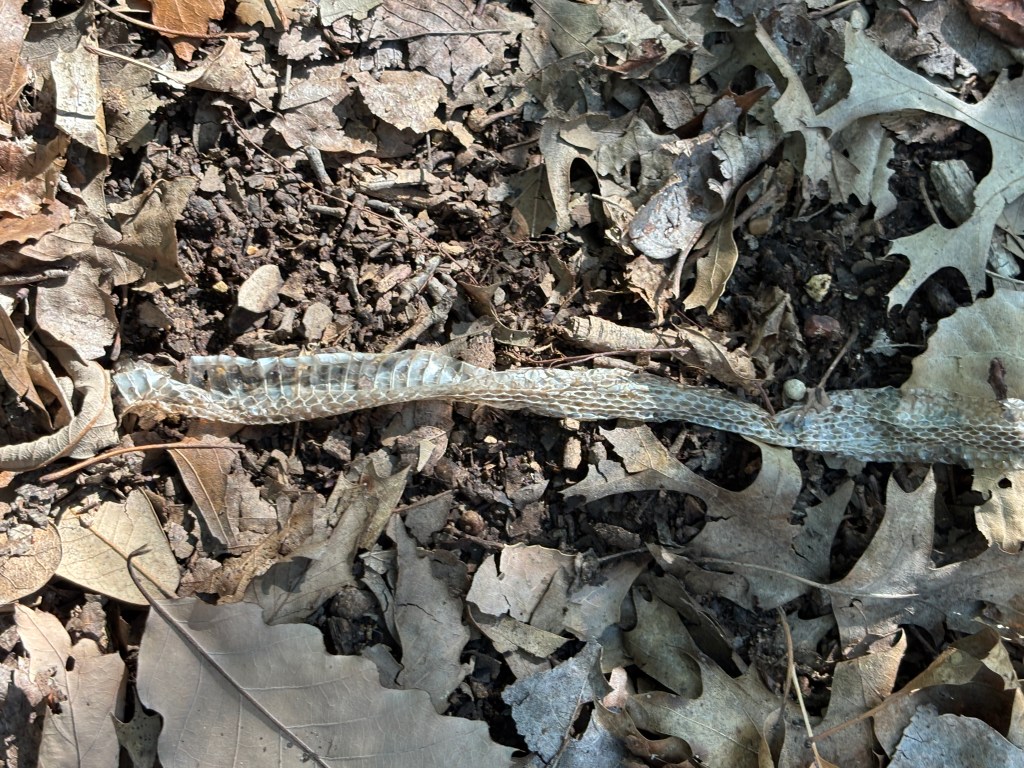
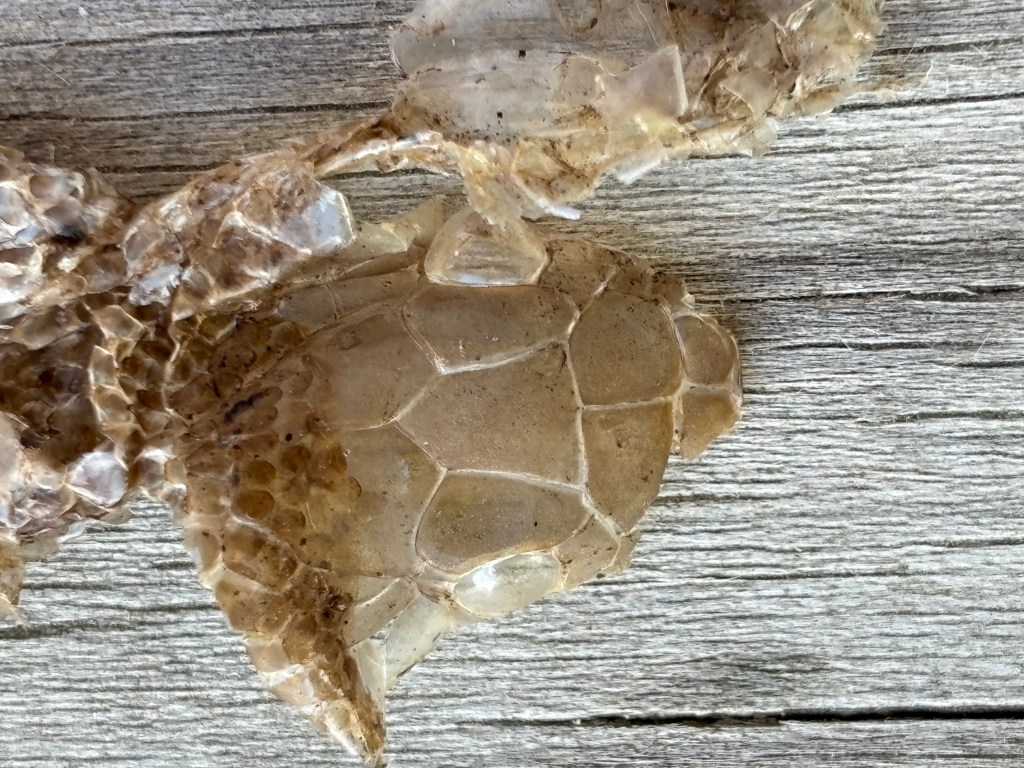
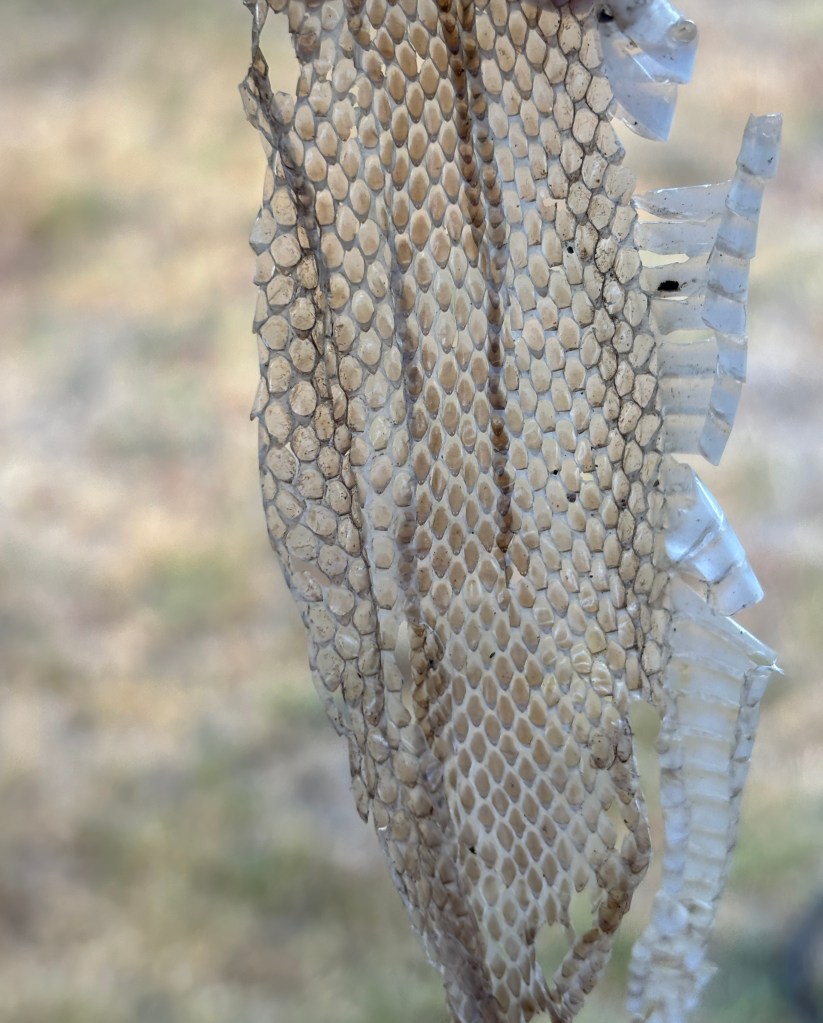
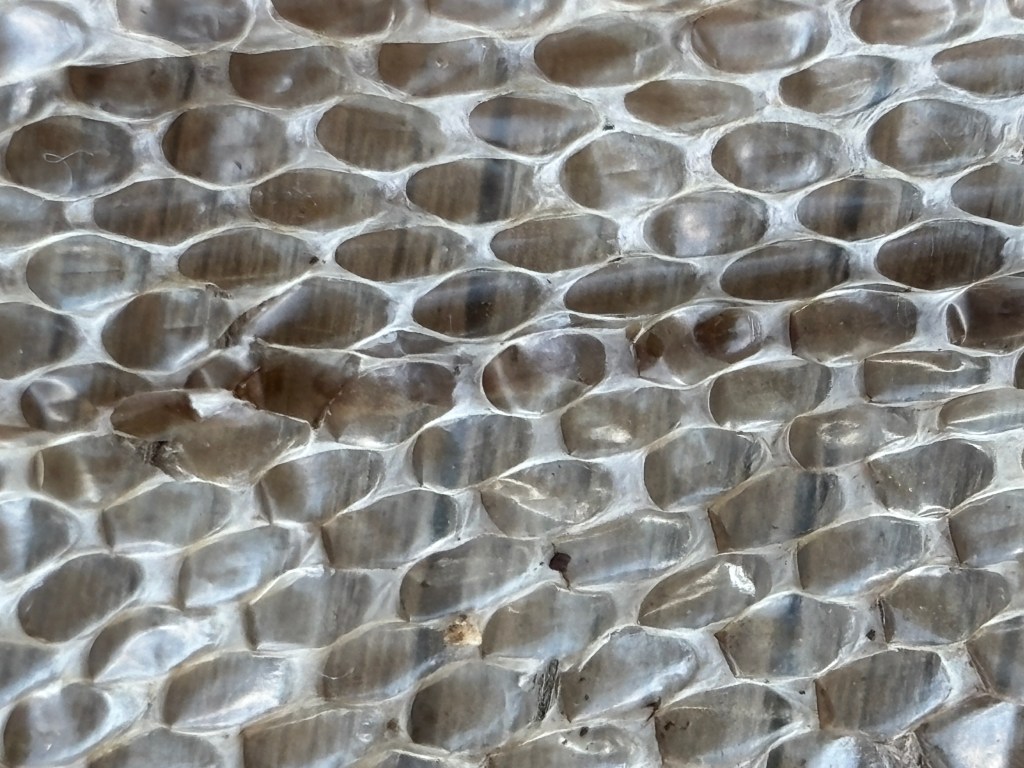
    The other thing we found near the road was a shed snake skin, with the head and first half or more of the skin intact. Often we can identify the snake (or narrow down the possibilities) by carefully examining it. Are the dorsal scales bigger, or smaller? Are they keeled? Can we detect any pattern in the shed skin? Looking at it in the field, we agreed that the dorsal scales looked smooth and there was a suggestion of a striped pattern.

    Later, I dampened the skin to make it flexible and cut it at the edge of the dorsal scales so the tube of skin could be laid it and examined better. The trace of pattern now seemed more like alternating patches of dark and light (blotches down the back) and a really close look seems to show slight keels in the scales in the middle of the back. What was puzzling in the field seems likely to have been from a juvenile western ratsnake (Pantherophis obsoletus).

    The bottomland forest is an area with ash, cottonwood, hackberry, and other trees that can withstand periodic flooding. The ground is covered with a latticework of downed branches and logs, and that ordinarily provides lots of opportunities to see herps and other critters. The soil was dry, even under pieces of bark or branches that we turned over.

    But at some point, someone flushed a mouse (my best guess was white-footed mouse, Peromyscus leucopus but it’s only a guess) that ran up the base of an ash tree under loose bark. As we were trying to get a look without pulling bark off the tree, someone said “Copperhead!” and our attention quickly shifted to a beautiful snake at the base of the tree.

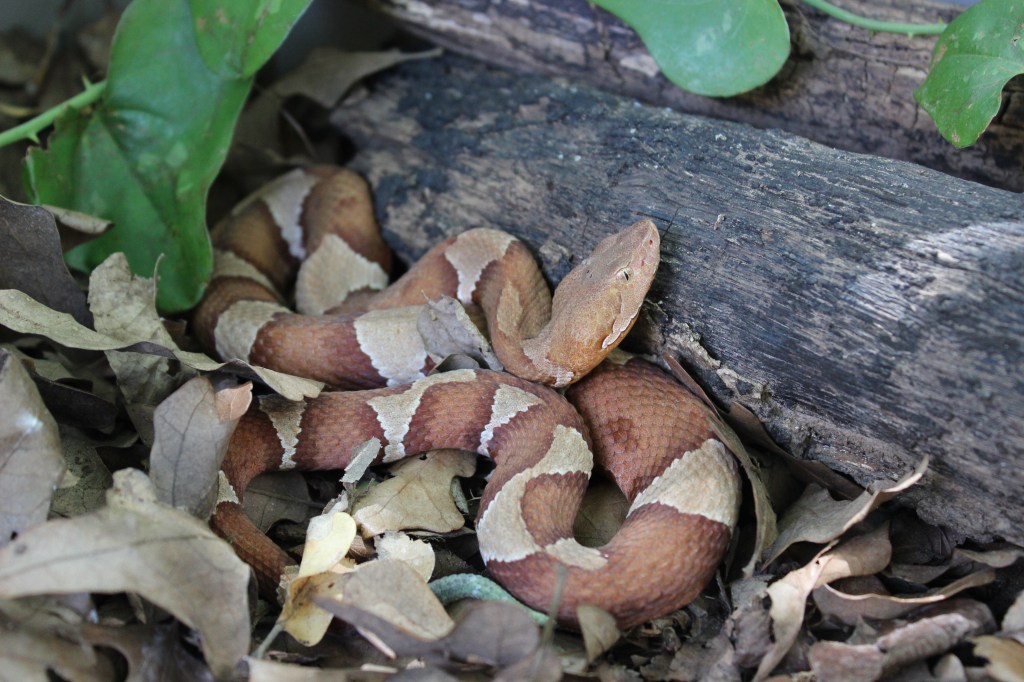
    Another broad-banded copperhead, this one from LBJ National Grasslands

    As it tried to get away, I used a snake hook to try to pull the copperhead back to the tree. I thought that, with a tree trunk behind it, the snake might feel less vulnerable and stop to see what threat it was facing. My goal was for the other participants to get a good look at the snake before we let it go its way. Often a pit viper such as this one, after being pulled back a time or two with a hook, will coil up momentarily. Not this one. This broad-banded copperhead (Agkistrodon laticinctus, according to the latest taxonomy) got under a big log and there was no getting it out.

    From the other side of the log, Shay was able to help the others see a bit of the snake’s coil under the log, but the copperhead stayed put. We found him or her as each of the subsequent two groups of Master Naturalists came through the area, sometimes with the snout visible and watching for danger, but never willing to emerge.

    Participants found a rough earthsnake or two (Haldea striatula) and a couple of Gulf Coast toads (Incilius nebulifer), and – being Master Naturalists – they admired all kinds of other things including the ironclad beetle (Zopherus nodulosus haldemani), a recluse spider (Loxosceles sp.), and a wolf spider (probably Hogna sp.)

    By early afternoon the temperature was reaching 100 degrees and we were wrapping up a good day at the nature center, really a better outing than I might have expected.

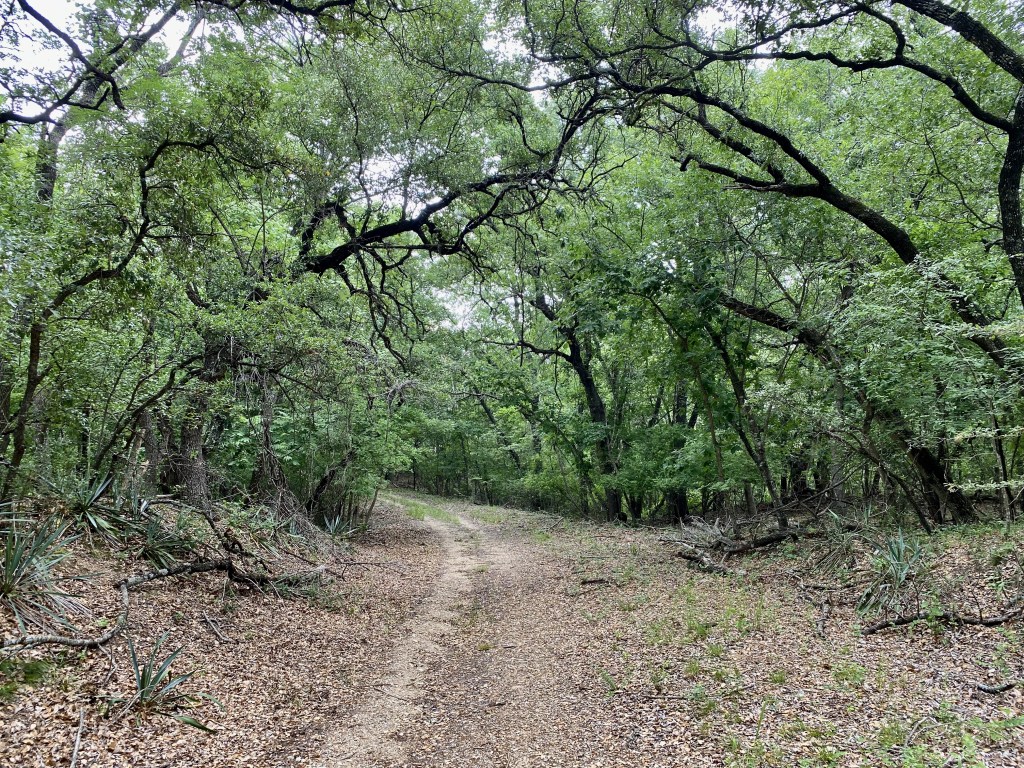
    The road into the bottomlands, seen in 2022

    I also managed to put in the good word for keeping field notes with some of the groups. Because it would be hard in that context to stop frequently and get the notebook out, I dictated some things about the location, weather, and then each of the herps we found and what they were doing. I warned the students that dictating notes runs the risk that you never get around to transcribing them into a notebook.

    I also promoted the use of good field guides. As wonderful as iNaturalist is, I don’t think it would give us information about the scale differences that would let us determine which of the skinks we saw. And good field guides provide some natural history information that can be helpful in the field. As I told the incoming Master Naturalists, knowing about things like habitat or diel (day vs. night, etc.) activity can help you know how to look for certain species.

    So, a “thank you” to the Master Naturalists for hanging in there, combing through the woodland, asking good questions, and being good observers on this outing. Hope to see you again.

  • Finding Our Way in the Prairies and Woods

    I know my way around most of the LBJ National Grasslands (LBJNG), in Wise County. I have driven up there more times than I can remember over the past 25 years, and I can navigate that network of county roads, day or night. In several of the Grassland’s units where I often walk, I can follow the network of trails without taking a wrong turn. I have to add that any turn you take is likely to bring you to some new meadow, some new hidden pond, or another dense oak woodland; it’s only a “wrong” turn if you are nearly out of water or time and needing to get back to the car.

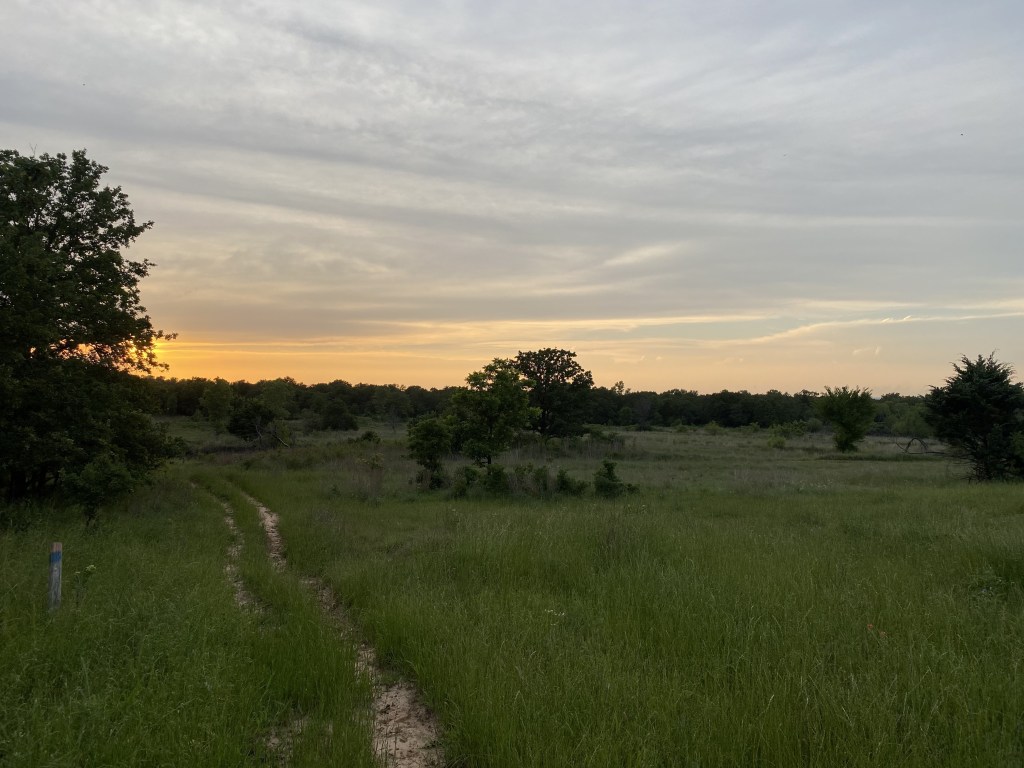
    LBJ National Grasslands, Unit 30

    To a lesser degree, I know my way around the nature of North Texas. That knowledge is about what the land and water are like, being able to recognize many of the plants, fungi, and animals of the region, and having some understanding of how it all works together. When land managers know such things, they can help us avoid wrong turns that can harm the ecoregion. The more our teachers can navigate the natural history of the Cross Timbers, the better they are at teaching and inspiring a new generation of nature kids. And when individuals and families know something about the trees, grasses, grazers, predators, and all the rest, they are better equipped to find their way home. Our goal in Cross Timbers Connection is to offer the tools and share the needed experiences to help us find our way.

    As I was first exploring LBJNG, two things helped me find my way around. One was an ability that comes from real-world experience. With practice over the years wandering roads through wild or semi-wild places, you get to where you kind of know which way you’re headed and where you came from. That knowledge lets you backtrack as if you had a map in your head, sort of. And in fact, most of us do. Finding your way around in places like that trains your brain and builds your spatial memory and spatial reasoning. Like a muscle, the more you use it, the stronger it becomes. The hippocampus and other areas within the brain get pretty good at knowing where you are and how you got there.

    The other thing that helped me navigate the Grasslands was a paper map. Not a GPS app that tells you to take this turn and that to get to a destination; a map – a picture of the landscape and its roads, which my brain could (on a good day) remember and visualize from different directions. And so, coming up to the intersection of County Road 2475 and 2675, where the road seems to split around a small, steep hill, I could say, “If I go to the left, I wind up circling around and going through some nice habitat before coming back to 2675.” Before that route was locked into my memory from experience, I could visualize it from the map. Maps are useful tools for finding your way.

    LBJ National Grasslands, Unit 29

    Later, of course, GPS apps became a thing. We all have mapping apps on our phones, and we plug in the destination and the phone tells us, “turn left” and “turn right,” and then we arrive. We didn’t have to pay much attention to how we got there. For some people for whom visualizing direction is inherently difficult, it is an important support. For most of us, it sidesteps the brain skills I mentioned above. We become dependent on the mapping program in our phone, not the one in our brain. In one study, fifty drivers were questioned about their lifetime use of GPS and then presented with virtual navigation tasks (without the app). Those with greater lifetime GPS use had poorer navigation abilities. And, three years later, those spatial ability skills declined even further with continued GPS use[i]. (Full disclosure: I do use GPS apps, particularly in urban settings, both for the route and for reports of traffic congestion.)

    My point is that navigation using experience and “analog” tools is a pretty good metaphor for how we understand nature and natural history. Direct experience is extremely helpful, as are intellectual, perceptual, and even emotional or cultural tools. Those tools should build “maps” based on information that helps us tie different things together, allowing us to see the big picture.

    We may start with knowing what a species looks like. While walking in the Cross Timbers, something looks back at us from across a meadow. Standing alert and attentive, with those yellow eyes sizing up our potential for threat, pointed ears up, catching every sound. That long muzzle, white around the mouth, the bushy tail, the graceful body with tawny and grizzled gray fur. Too big for a fox and too small for a wolf. A coyote, Canis latrans. By the time this has registered, the coyote turns and disappears into the brush.

     A naturalist’s calling is to know more – the details of its habitat, the variety of its prey and predators, the phenology of its life from day to day, season to season, and (the subjective part) how we and others respond to its form, beauty, utility, perceptions of its skill or ability to persevere, and its place in the world. Or even to take what we observe and create stories that guide or enrich our own lives. I’m thinking, for example, of the Indigenous stories and myths about the coyote. It’s not that we should confuse our personal or cultural reactions with objective data about coyotes. It’s just that we have a richer and more complete understanding of coyotes if we have the whole picture.

    Our aim is to be a resource that helps us find our way in the woods and prairies and to get to know all of it in a more holistic way. The articles in the Post Oak & Prairie Journal, the website, and other things we will do should help connect all of us with places, with plants, animals, and ecological communities. We would like Cross Timbers Connection to be a sort of meeting place for the naturalist community where some provide articles for the journal, some make use of the website, and everyone shares their ideas, hopes, and suggestions. We imagine bringing that naturalist community together (face-to-face and digitally) and spreading the word about others who are hosting meetings and doing other good work. What would that look like in your part of the naturalist neighborhood? We would love to hear from you (using the Contact form or emailing masmith.tx@gmail.com).

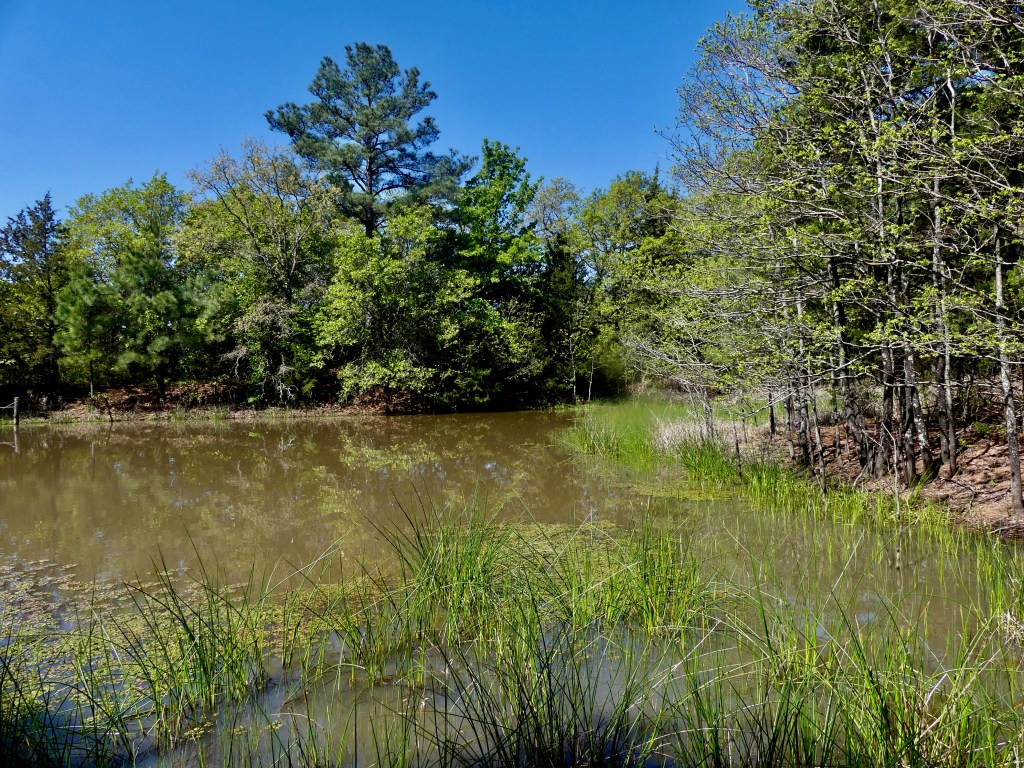
    A pond within Unit 30 of LBJ National Grasslands

    [i] Dahmani, L. & V.D. Bohbot. 2020. Habitual use of GPS negatively impacts spatial memory during self-guided navigation. Sci Rep 10, 6310, https://doi.org/10.1038/s41598-020-62877-0